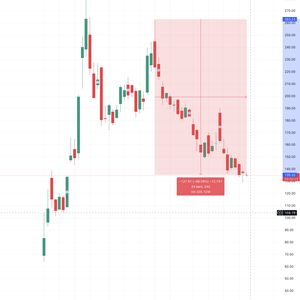
Summary I rate Circle (CRCL) a BUY, driven by resilient reserve yields and accelerating USDC network monetization, especially via the FIS banking partnership. Circle’s fundamentals are strong: Q2 revenue grew 53% YoY, USDC circulation is expanding, and network-driven income is gaining traction beyond reserve yields. Key risks include regulatory divergence, interest rate cuts compressing reserve income, and execution risks in banking integration and competition from Tether. I see asymmetric upside after the correction to $130/share; catalysts include index inclusion, enterprise adoption, and improved transparency. Reserves Today, Monetization Tomorrow Circle's(NYSE: CRCL ) price is currently driven mainly by the Fed's rate decision and adoption. There are opinions that the Fed will cut rates and companies will see a significant drop in reserve yields. However, inflation in the US is holding up more than expected, and the Fed will not cut rates so quickly that it will devalue reserve yields. Then we have the second significant change, and that is OTC:USDC , which is growing in circulation at an ever-increasing rate, and is also heading from the crypto world to banks thanks to the FIS partnership. After a relatively fresh and dynamic return to the price of $130 per share, we are at a point where it makes sense for me to re-enter this company. At least one of the above variables will work and bring rewards to investors. Either higher rates will remain, or transaction monetization will take off to a greater extent. I see a combination of both as a realistic scenario, which is why I chose a BUY rating, which narrowly missed STRONG BUY, the reasons for which will be explained below. Chart of CRCL (TradingView) From Euphoria To Doubt I was interested in how quickly the cards can turn. At Circle, we could see one bolder headline than the other before earnings. Everything was bathed in sunshine and everyone saw a bright light. After earnings, the cards turned and I can't help but be surprised at how much attention is currently being paid to the quality of sales. In essence, all negative sentiment turns to the quality of the company's sales, which it translates as a carry trade on rates, and that functional transaction channels for banks are still in sight. I would like to disagree here, because on the one hand I think that rates will stay with us longer (inflation, fiscal policy, AI CAPex), and on the other hand Circle is gradually moving from carry trade to monetizing its network. I perceive the more dynamic depreciation of the share price to $130 more as a cleansing of overly optimistic sentiment than as a warning signal. Circle is a relatively new name on the exchange, but it is among the veterans in the crypto world. It is a fintech that issues USDC, which is 100% backed by cash and other highly liquid substitutes with immediate 1:1 convertibility. Circle is trying to gradually turn USDC into transaction paths that technically rely on CCTP (Cross-Chain Transfer Protocol), which is supposed to increase capital efficiency. In addition, thanks to the partnership with FIS , USDC will appear in MMH (Money Movement Hub) alongside RTP, FedNow and ACH as another real-time corridor for banking houses. The shares have experienced a sharp rise after the IPO, and are currently in a healthy correction. Even if the market wanted to question the quality of the returns, Circle is not a pure carry trade on rates. In my opinion, reserve yields will not disappear overnight (the Fed has no reason to rush due to inflation data ), and in the meantime, the part of our business that is independent of the level of rates (network, volumes, and bank distribution) is growing. Circle's principles (Circle.com) What Do We Know So Far I would start with the numbers, because when we clear the noise, the facts remain. Q2 brought in total revenue of $658 million (+53% YoY). At the same time, USDC in circulation increased to $61.3 billion and annual transaction volume swelled to $6 billion. The data provides us with information that the network expansion is going well. On the other hand, yes, the accounting results were affected by non-cash items after the IPO , however, this does not change the fact that the “engine” in the form of the network is running and functioning. Then there is a new share subscription. If this were an emergency brake, the company would have fallen significantly below $130 per share after this information. The reality is that out of 10 million shares, 2 million went to the primary subscription, and 8 million to the secondary with a price anchor of $130 per share. This can serve as a new measure of liquidity and a reference range through which we can continue to grow after the sentiment calms down and the fundamentals do not disappear. And as for the banks? This is where the debate most often goes. The partnership with FIS is not a blogpost for the crypto community, but it is a detailed integration of USDC into MMH. The construction of infrastructure such as RTP, ACH, etc. will not be reflected in sales overnight, but in 6-12 months in volumes that are no longer just for the crypto market. Data First Circle reported total revenue of $658.1 million in 2Q25 (+53% YoY). The revenue mix is very conservative. Reserve income (T-Bills + interest on cash) is $634.3 million, other revenues of $23.8 million are from the network (subscription & services + transaction fees). Transaction distribution costs reached $406.9 million (+64% YoY), which reflects both a higher volume of USDC in circulation and a higher share of “on-platform” holding with partners and new distribution agreements. After deducting these costs, RLDC comes to $251.1 million, or a margin of 38%. Proportionally, this means that for every $1 (revenue + reverse income) after deducting distribution and transaction costs, $0.38 remains to cover OPex. These then jumped to $576.7 million in the last quarter, but the majority is a one-time item ( IPO ). Stock-based compensation alone is $435 million. The core of OPex is payroll and other compensation costs of $503.4 million, including SBC. Then there is G&A of $43.1 million, depreciation of $14.2 million, IT of $8.8 million, and marketing of $7.9 million. Circle ended up with a loss of $-325.6 million. The company’s post-IPO balance sheet is massive, but the structure is specific to any other stablecoin issuer. Total assets of $64.15 billion are impressive, but cash equivalents segregated for stablecoin holders are $61.37 billion. Then there are some cash equivalents and investments at the corporate level. When we add it all up, we have cash just over $1 billion, and the company’s overall debt is low. Management is targeting full-year 2025 revenue of $75 million. up to $85 million excluding reserve income. He would like to keep the margin at 36-38%, and OPex in the range of $475 million to $490 million. This is essential to our idea, because even if reserve income starts to gradually weaken due to rates, the company is aiming to create a solid revenue mix, which will shift mainly to a transaction-oriented structure. At the same time, management is interested in keeping OPex under control. Example from F24: How CRCL makes money (AppEconomyInsights) How To Price a Stablecoin Issuer It’s quite a challenge to get a valuation for Circle, as there’s not much to compare it to. However, I look at Circle through metrics that are appropriate for a stablecoin issuer. The cornerstone is RLDC (Revenue Less Distribution Costs), which is essentially gross profit after paying distribution and partnership costs. In 2Q25, Circle had total revenue of $658.1 million and RLDC of $251.1 million, along with EBITDA of $125.8 million. With a current market cap of roughly $31 billion and very low corporate debt (approximately $1.1 billion), my EV comes out to somewhere around $30.4 billion. The reserves covering USDC are segregated and are offset by corresponding liabilities, so I don’t include them in the EV. The multiples that are an approximation of Q2 until we have a longer time series are as follows: EV/TRRI = 11.6x (gross EV/Sales) proxy EV/RLDC = 30.3x (closer to reality because it reflects the shared economy of distribution costs) EV/EBITDA = 60x (very high so far, but Q2 EBITDA is after distribution and before the IPO-SBC shock costs) We are also interested in the multiples specific to stablecoins: EV/USDC = 0.5x (the market pays approximately $0.5 EV for every dollar of stable float) EV/Meaningful Wallets = $5300 (price per active address, useful as a rough estimate for network monetization over time) How USDC growth (Circle.com) If we wanted to compare Circle with indirect competition that we already have on the exchange, we can interpret the data as follows: Coinbase(NASDAQ: COIN ) - EV/Revenue at approximately 10 to 11x, EV/EBITDA at approximately 35x and EV/S + EV/TRRI is like Circle, except that COIN is purely transactional, without a carry trade on rates. Then we can compare Paypal (NASDAQ: PYPL ), which has EV/Revenue as 2x. It has low multiples, and it is a mature business model, but it is without a significant "network carry" with a different margin structure. And lastly, I would mention omni-fintech Block (NYSE: XYZ ), which has EV/Revenue of 1.7x and again it is a traditional payments/e-commerce mix, which is traded at low multiples. For a fresh IPO without a long history, it is fair to use EV/RDLC and its multiples from the network instead of the classic EV/Sales. In this world, Circle is not cheap, but it is not expensive compared to COIN, if we believe in longer-term higher rates and that the FIS channel will bring monetization outside of revenue from reserves. Compared to large payment channels like PYPL and Block, we pay a premium for growth and the creation of new channels. It has its drawbacks, but I believe that the Fed will keep rates higher for a longer period of time, and that FIS will lead to better monetization of the network, which is why I remain BUY, which is close to STRONG BUY. However, it would need a stronger push to the goal in the form of faster adoption at STRONG BUY. Regulation, Rates, Adoption My investment thesis could be disrupted in the event of regulatory changes and rule fragmentation. US stablecoins are heading towards federal regulation, but for now they are subject to a mix of federal/state regulations (NYDFS, daily liquidity, instant convertibility), while on the other hand the EU is already running MiCA with its own licensing and security requirements. If the final US framework deviates significantly from the EU one, Circle may face a dual product solution (higher costs, slower roll-in to bank integrations). For the investor, there is then the risk of a binary development, where a regulatory inhomogeneous environment will reduce multiples, and different regimes will put margins under pressure. As many other analysts have already mentioned, there is also interest rate risk . My thesis assumes that the Fed will not rush to raise rates due to inflation. However, if the data improves and a faster rate-cut cycle comes, then the yield from reserves will compress faster than monetization on FIS transactions is built. This would pull down TRRI and narrow RLDC's margin despite higher distribution costs. So, it is important to watch the short end of the curve and the overall consensus of economists for rate cuts this year. I would also like to not forget about the execution risks on the part of the company. 2Q25 showed strong total revenue, but after paying partners and covering transaction costs, RLDC remained at $251 billion. If the bank integration via FID gets underway with a higher partner "take rate" and volumes grow slower than expected, RLDC's margin may temporarily decline further. In addition, competition in the form of Theter ( USDT ) will put pressure on the price. This is the most significant risk for me at this point that can throw off my thesis. Trigger Points In the short term, the price may fluctuate mainly based on several key moments . If Circle soon gets into major indices such as MSCI world( URTH ) or Russell2000 ( IWM ), it will trigger mandatory passive purchases and a more permanent influx of liquidity, which often keeps the share price at a new price level. Another catalyst is enterprise adoption, as soon as ISDC is natively installed in treasury/ERP systems (SAP, NetSuite, Helios) and Circle shows the first case studies from corporate payments, the “crypto” will become a regular operational money rail for B2B. Another impetus for a more dynamic movement of the share price may come from remittance corridors with large telco/fintech wallets in Latin America and Asia. Zero or low fees and guaranteed settlement can quickly add volumes outside the crypto-dative channel. The last strong impetus would be a shift to almost real-time reporting of reserves and the adoption of a tougher external audit. Better transparency usually reduces the discount to the competition and could trigger a re-rating for fresh IPOs. Once more conservative money sees this, there will be an influx of capital. I'm Buying Now.. So why BUY and not STRONG BUY, that's what I want to talk about in the comments. My investment thesis is relatively simple. Circle today is based on two engines that overlap. The first is the carry-trade of reserve yields, which I think will not just disappear due to stubborn inflation and a cautious Fed. The second is the monetization of the network, USDC is growing in circulation and volume and thanks to FIS it is moving from the crypto world to the banking world. After a quick pullback to $130 per share, I see an asymmetric opportunity for entry. If reserve yields fail due to rate cuts, transactions will come, but in my realistic scenario both engines will run simultaneously. Yes, regulation, rate-cuts, and poor take-rate execution are real risks, but that is why it makes sense for me to look at Circle through the lens of EV/RLDC and EV/USDC. An external game changer would be inclusion in indexes, or adoption into ERP/Treasury. But I'm interested in your counterargument regarding the rate cut, if it really happens, by how much? Will a 25bps cut really hurt Circle that much? How quickly will we see the first adoptions in large enterprises? And where do you think RLDC margins can go if banking channels are educated?