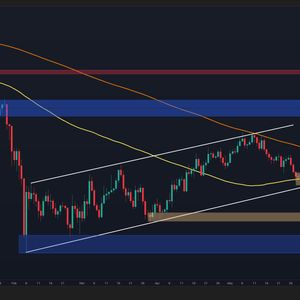
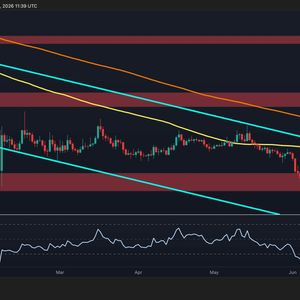
Bitwise CEO Hunter Horsley has urged crypto investors to take a longer view as Bitcoin, Ethereum, and other digital assets face renewed pressure from market weakness, exchange inflows, and a wider shift in investor attention toward artificial intelligence and major technology listings. In comments shared on X, Horsley said crypto investors should not measure the sector by weekly headlines or monthly price moves unless they are trading short-term volatility. He said investors should focus on substance, including usage, on-chain technology with product-market fit, corporate adoption, institutional activity, team quality, and execution. His comments came as Bitcoin attempted to hold a key support range near $60,000 to $62,000, after falling below the $64,000 area. A move from $64,000 to $60,000 would represent a decline of about 6.25%, while a drop to $62,000 would equal roughly 3.13%. Market attention has also turned to exchange inflows from older Bitcoin holders, with activity rising among coins held for three to six months and six to 12 months. Horsley Says Crypto Should Be Measured Over Years, Not Weeks Horsley compared the development path of crypto with other technology platforms that took years to reach mainstream visibility. SpaceX was founded in 2002, OpenAI in 2015, Bitcoin in 2009, Ethereum in 2015, Solana in 2018, and Hyperliquid in 2024. He said the public often sees technology successes only after long development cycles, while the early years include funding pressure, market setbacks, and periods of doubt. The Bitwise executive said investors in crypto may feel “quietly jealous” of AI and SpaceX but added that major technology stories rarely develop in a straight line. OpenAI launched ChatGPT seven years after its founding, while SpaceX spent more than two decades building toward its current market position. Horsley also drew a line between investors and traders. He said anyone whose conviction depends on what happens in the next 12 months is operating more like a trader than a long-term investor. He noted that both approaches can be valid, but they use different timeframes and risk frameworks. Bitcoin Faces Older-Coin Exchange Inflows as Price Tests Support On-chain data cited in the market discussion showed higher exchange deposits from medium-term Bitcoin holders. The Exchange Inflow Spent Output Age Bands chart reportedly showed rising activity from the three-to-six-month and six-to-12-month cohorts, with recent spikes among the largest visible on the chart. When older coins move to exchanges, analysts often monitor the activity as a possible distribution. Coins that stayed inactive for months may be transferred to trading venues where they can be sold or used as collateral. A single spike does not confirm selling pressure, but repeated inflows during a price decline can point to weaker holder conviction. Source: X Bitcoin’s near-term market structure remains focused on the $60,000 to $62,000 zone. A short-term bounce has been noted, but sustained recovery would require stronger buying, lower sell-side pressure, and improved spot demand. Exchange inflows from older holders may remain a key data point for traders watching whether the correction continues or stabilizes. At the same time, some market participants have reduced crypto exposure. Trader Eugene was cited as saying he had largely exited crypto and shifted toward U.S. equities, citing weaker risk-reward conditions in digital assets. He also expressed a bearish view on Strategy and Michael Saylor, pointing to the company’s high correlation with Bitcoin. AI Funding and SpaceX IPO Add Pressure to Crypto Liquidity Michael Saylor has attributed the June 2026 crypto downturn to a large capital rotation into AI infrastructure and major technology offerings. According to the view attributed to Saylor, capital markets absorbed about $400 billion over six months to fund frontier AI buildouts, including data centers, GPU chips, and related infrastructure. Consequently, the market narrative has pointed to the planned SpaceX IPO as another source of liquidity demand. As we reported, SpaceX is scheduled to list on Friday, June 12, under the ticker SPCX on Nasdaq, seeking to raise $75 billion by selling 555.6 million shares at $135 each, valuing the company at about $1.77 trillion. Meanwhile, according to CoinCodex’s SpaceX Pre-IPO stock forecast , SPAX is projected to rise from $125.83 to $126.40 over the next month and $132.86 over three months. Saylor argues that Bitcoin, as a highly liquid risk asset, can be sold by institutions when capital is needed for other large allocations. In that framework, outflows from Bitcoin funds and weakness in crypto prices do not necessarily reflect a breakdown in network fundamentals, but rather a temporary reallocation of capital toward AI and public market technology deals.