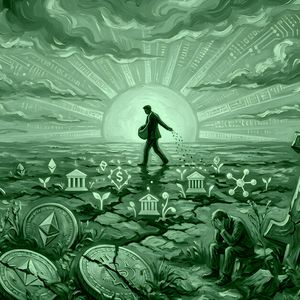
Over the last year, I’ve had the same conversation again and again — with founders, investors, operators, people in completely different industries. The details change. The conclusion doesn’t. Something feels off. Not in a dramatic, headline-driven way. More like a quiet realization that the rules people relied on for the last decade don’t seem to produce the same results anymore. There are wars happening, and more that feel uncomfortably close. Trade relationships are shifting. Countries are protecting themselves again. Inflation changed how people think about money. Some currencies are quietly losing relevance. Social tension is rising in places that used to feel stable. At the same time, AI is moving faster than most businesses can absorb. Products that once took years to build can now be replicated in weeks. Entire categories of software suddenly feel temporary. None of this, on its own, is unusual. Markets have always had cycles. Technology has always disrupted industries. Politics has always introduced uncertainty. What feels different now is the overlap. Multiple systems are changing at the same time — economic, technological, geopolitical — and when that happens, people don’t immediately panic. They hesitate. They sense that something has changed, but they can’t yet explain what. The problem isn’t the economy The problem is that the assumptions stopped matching reality. A lot of smart people I know are still making decisions using models that worked in a more stable world. They look at historical returns and assume those relationships still hold. They evaluate AI based on what it does today instead of where it’s clearly heading. They build businesses around gaps that may disappear before the company matures. None of this is irrational. It’s just slow adaptation. The environment shifted faster than the mental models people use to interpret it. That creates a strange outcome where intelligent decisions, made logically, still lead to disappointing results. Capital doesn’t know where to go One thing I keep noticing in conversations with investors is hesitation. Not fear. Hesitation. Stocks are near highs, but conviction is low. Crypto achieved institutional acceptance, yet feels less transformative than it once did. Gold and silver move sharply enough that they’re traded rather than trusted. Real estate works in some regions and stalls in others once currency risk and financing costs are considered. Manufacturing looks attractive until geopolitics enters the picture. A policy change or conflict can undo years of planning overnight. So capital rotates. It searches. It waits. When nothing feels obviously right, people default to the past. They look for the last cycle’s winners and try to apply the same logic again. But this doesn’t feel like another cycle. It feels like a transition between systems. And transitions are uncomfortable because clarity disappears before new patterns become visible. Where smart people are misreading the moment The mistake I see most often isn’t lack of intelligence. It’s time horizon. People are solving for the present snapshot instead of the trajectory. AI is the clearest example. Many people evaluate it based on what it can or cannot do today. But anyone using it seriously can see how quickly the baseline is moving. Founders are building AI businesses that may not exist a year from now because the capability becomes part of the infrastructure itself. Investors are still trying to time individual assets based on volatility instead of asking what role those assets play when uncertainty itself becomes persistent. The focus remains on products and prices. The real change is happening underneath — in what remains scarce. When building gets easier, other things matter more AI is lowering the cost of building almost everything digital. That sounds purely positive, and in many ways it is. But it shifts where value lives. If everyone can build software, generate content, or launch products, then building stops being the advantage. Access, distribution, and trust begin to matter more. And physical reality starts to matter again. Food. Water. Energy. Logistics. Housing. Local demand. These aren’t glamorous themes in technology circles, but they are difficult to replace and slow to disrupt. They exist in the real world, where infrastructure, regulation, and execution create friction. At the same time, AI is turning more people into entrepreneurs. Supply increases. The harder question becomes whether demand keeps up — especially in an environment where economic pressure changes how people spend. Being able to create something is no longer rare. Getting people to consistently buy it might be. Why some businesses feel harder to justify now This shift also changes how operating businesses are evaluated. Take something like a hotel or resort. Traditionally, you accept years of operational effort for long-term steady returns. But if the financial outcome resembles what passive capital can generate, the equation changes. Why take operational risk for a decade unless the business creates something beyond the direct return? The justification increasingly becomes strategic — ecosystem effects, long-term positioning, or connected opportunities that create optionality over time. Businesses built purely for linear returns feel less compelling in a world where capital itself can generate similar outcomes with less operational complexity. The focus shifts from owning isolated assets to building systems around them. What seems to be changing beneath the surface We’re moving into a period where intelligence and capital are becoming more accessible, while stability becomes harder to find. AI increases productivity. Global fragmentation increases uncertainty. Those forces together change what survives. The most valuable positions may not belong to whoever builds the most advanced technology, but to whoever sits closest to unavoidable demand — the places where consumption continues regardless of market narratives. Local markets. Physical infrastructure. Distribution networks. Essential services. Technology doesn’t disappear in this world. It simply makes everything else cheaper and faster, which changes where margins and resilience live. What this means in practice The question I find myself asking more often now isn’t “what grows fastest?” It’s “what still works if conditions get worse?” That changes how capital is allocated. It changes how businesses are started. It changes how much reliance you place on a single narrative continuing indefinitely. Diversification starts to look less like caution and more like realism. Geographic flexibility matters. Businesses built purely on digital advantage look fragile compared to those tied to real demand. And perhaps most importantly, it requires accepting that change is accelerating rather than slowing. The uneasy part This period feels uncomfortable because we’re between stories. The old ones — predictable globalization, stable growth, clear cycles — no longer explain what’s happening with enough accuracy. The new story hasn’t stabilized yet. So everything feels uncertain at once. That doesn’t necessarily mean things are getting worse. Often it means risk is being repriced across multiple systems simultaneously. The future isn’t disappearing. But the assumptions that once made decisions straightforward are fading. And people who tend to do well in periods like this rarely move loudly. They adjust early. They reposition quietly, before consensus forms. Something is changing. Not a collapse. Not a boom. A transition. And transitions tend to reward the people who recognize early that the environment itself has shifted — and start preparing for what remains necessary no matter what happens next. – Karnika E. Yashwant