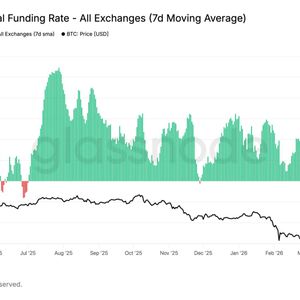
Bitcoin’s attempt to reclaim the psychologically significant $76,000 level stalled on Tuesday, with the largest cryptocurrency by market capitalisation pulling back to approximately $74,300 after briefly touching $75,900 during the US trading session. While the reversal disappointed traders who had been hoping for a decisive breakout, the underlying conditions in the derivatives market tell a story that some analysts believe points toward a sharp upside move in the near term. The session began with genuine promise. Bitcoin climbed over 5% on Monday as risk assets rallied broadly following diplomatic signals that US-Iran peace talks could resume in Pakistan within days. The $73,000 resistance level that had capped prices for over two months finally gave way as global equity markets erased their war-related losses, drawing crypto capital back into the market alongside gains in the Nasdaq and S&P 500. That break above the six-week ceiling set the stage for Tuesday’s attempt to extend the rally. What stopped the move at $76,000 was not a lack of buying demand but rather the concentration of sell orders at that specific level. Vetle Lunde, head of research at K33 Research, described the situation as a market in which funding rates on Binance’s Bitcoin perpetuals have remained negative for 46 consecutive days, even as open interest has been rising throughout the recent price recovery. That combination — rising open interest alongside persistently negative funding rates — is a technical signal that new short positions are being added rather than existing ones being closed, creating the conditions for a mechanics-driven squeeze when selling pressure finally exhausts itself. “Overall, the past 24 hours reflect a market that is beginning to show signs of re-engagement,” said Joel Kruger, market strategist at LMAX Group. He pointed to improving technicals and broader participation across the crypto market as evidence that the rebound has more structural foundation than a simple short-term bounce might imply. Kruger identified the $76,000 level as a critical test, noting that a decisive daily close above it would open the door to the mid-$80,000s where the 200-day exponential moving average currently sits at approximately $83,218. Ethereum significantly outperformed Bitcoin during Monday’s session, rising 8.80% against Bitcoin’s 5.15% advance and approaching the critical $2,400 resistance zone. The relative outperformance of Ethereum is generally interpreted by crypto analysts as a risk-on signal within the digital asset class, as investors with higher risk tolerance tend to rotate from Bitcoin into Ethereum and subsequently into smaller-cap altcoins as confidence builds. Spot ETFs for Ethereum recorded their strongest week of net inflows during the period, an on-chain signal that institutional capital is selectively reengaging with the second-largest cryptocurrency. Total crypto market capitalisation expanded by 4.53% during Monday’s session to reach $2.52 trillion, with short liquidations of $446.75 million out of total liquidations of $549 million confirming the mechanical short-squeeze dynamic that had been building. The asymmetry between forced short covering and forced long liquidations — more than four to one in favour of shorts being squeezed — provided upward price pressure that fed on itself in the way that large liquidation events typically do. Bitcoin’s current price sits approximately 40% below the all-time high of $126,000 reached in 2025, a gap that contextualises even the recent recovery as partial at best relative to the prior peak. The combination of geopolitical disruption, the US-Iran conflict driving oil prices above $100 for weeks, tax selling pressure ahead of April 15 and deteriorating consumer sentiment has created one of the more sustained and multi-causal drawdown periods the market has experienced. Bitcoin posted its first back-to-back quarterly losses since 2022 in Q4 2025 and Q1 2026. A key near-term catalyst sits on today’s calendar. The SEC’s CLARITY Act roundtable, scheduled for April 16, could provide further regulatory guidance on the classification of crypto assets — a development that analysts categorise as historically bullish when the signals are constructive. The CLARITY Act has been positioned by the crypto industry as a framework that would bring greater legal certainty to token issuance and exchange operations in the United States, and any positive signal from the roundtable proceedings could act as an accelerant for the rally that has already begun. The longer-term structure remains relevant context. Bitcoin’s next halving event, estimated for approximately April 2028, will cut the block reward from 3.125 BTC to 1.5625 BTC. Each of the previous three halving events has historically preceded a significant bull cycle in the 12 to 18 months that followed, though past performance in a young and structurally evolving asset class carries meaningful limitations as a predictive framework. For now, the market’s eyes are fixed on the $76,000 level and what happens if and when it is finally broken with conviction.