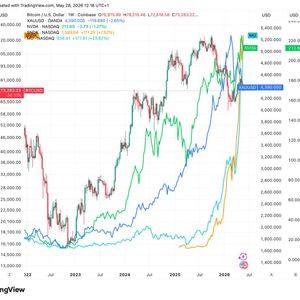
Bitcoin has fallen more than 4% over the past 24 hours, sliding toward $72,800 as geopolitical tensions in the Middle East and a strong US dollar pressured sentiment across the crypto market. According to CoinGecko data, Bitcoin traded near $72,800 during early Asian hours on May 28 after losing the $73,000 region overnight. The latest decline has extended Bitcoin’s pullback from its recent highs above $82,000 earlier this month, with sellers steadily regaining control after repeated failures to reclaim resistance between $80,000 and $82,000. Across derivatives markets, traders have attempted to defend the $70,000 support zone through new leveraged long positions. Even so, institutional demand has continued to weaken, adding pressure to the ongoing correction. Macro tensions pressure Bitcoin Fresh geopolitical developments in the Middle East have emerged as one of the biggest catalysts behind the latest drop in Bitcoin. Over the past two days, market sentiment deteriorated after the US Central Command launched airstrikes on facilities in southern Iran near the Strait of Hormuz, according to military officials cited in regional reports. The strikes came shortly after Iran rolled out Hormuz Safe, a maritime insurance platform reportedly designed to process global shipping transactions using Bitcoin in an attempt to bypass international banking systems and sanctions. Investors responded by moving capital away from volatile assets and into traditional safe-haven markets such as gold and the US dollar. At the same time, regional tensions escalated further after Israeli Prime Minister Benjamin Netanyahu ordered expanded military operations in southern Lebanon following the collapse of a temporary ceasefire extension between Israel and Lebanon. Concerns surrounding disruptions to critical shipping routes and energy markets added to the risk-off environment that has weighed on crypto assets this week. Pressure on Bitcoin intensified as the US Dollar Index climbed sharply amid the geopolitical turmoil. Investors have also been repositioning ahead of major US economic releases, particularly the second estimate for Q1 GDP and the April Personal Consumption Expenditures index, which the Federal Reserve closely tracks for inflation. Market participants fear that stronger economic data and persistent inflation could reduce the chances of a June rate cut by the Federal Reserve. A stronger dollar and elevated Treasury yield expectations have historically pressured non-yielding assets such as Bitcoin. According to Bitfinex analysts, investors are treading cautiously heading into Thursday’s PCE report. In a market note, the analysts stated that Bitcoin futures open interest has fallen sharply since May 15, when Bitcoin fell below $82,000. According to Bitfinex analysts, aggregated global open interest has now slipped below $55 billion, its lowest level since April 11, after declining 14% from levels recorded while Bitcoin traded above $80,000. Simultaneously, derivatives positioning has also supported downside pressure. Once Bitcoin fell below local support levels near $76,200 and $75,500, the move triggered stop-loss liquidations and forced long exits across futures exchanges. The drop below the 100-day simple moving average further weakened short-term momentum. Additional pressure has emerged ahead of the May 29 monthly options expiry on Deribit, where billions of dollars in open interest remain active. With the reported “max pain” level sitting near $75,000 and heavy call option exposure clustered around $80,000, options traders have reportedly hedged positions by selling spot Bitcoin into weakness. Bitcoin price analysis On the daily chart, Bitcoin has now dropped below its 20-day and 50-day exponential moving averages, which currently sit near $76,900 and $76,500, respectively. BTC/USD 1-D price chart. Source: TradingView. The flagship crypto is also trading below the 100-day EMA around $76,100, while the 200-day EMA near $81,200 continues to act as a major resistance zone. Repeated rejections below the 200-day EMA over the past several weeks have weakened bullish momentum and left Bitcoin vulnerable to deeper retracements. Sellers regained control after buyers failed to sustain momentum above $80,000 earlier in May. Momentum indicators have also deteriorated. Bitcoin’s daily Relative Strength Index has fallen toward 34, placing it close to oversold territory. The RSI has continued to trend lower after breaking beneath its moving average, showing that buying strength has weakened significantly during the latest sell-off. Trading volume has also remained relatively muted compared to previous major downside moves, suggesting that liquidity conditions remain fragile. In compressed market environments, sudden macro shocks often trigger exaggerated price swings because fewer buyers are available to absorb selling pressure. From a short-term perspective, traders continue watching the $70,000 region as a key support area. A decisive break below that level could expose Bitcoin to further downside toward the mid-$60,000 range, while any recovery attempt would likely face resistance near the $76,000 to $78,000 region. ETF outflows raise concerns over institutional demand Institutional demand for Bitcoin has also weakened notably over the past week as spot Bitcoin ETFs recorded sustained outflows. According to market data cited by Bitfinex analysts, spot Bitcoin ETFs saw more than $200 million in net outflows on Wednesday alone, while cumulative withdrawals over the past seven days exceeded $1.5 billion. Back-to-back outflows from spot Bitcoin ETF products. Source: SoSoValue. Bitfinex analysts also pointed to the negative Coinbase premium as another warning sign for Bitcoin’s current structure. The analysts said direct spot demand from US investors on Coinbase has weakened considerably in the post-ETF environment, where institutional exposure increasingly flows through ETFs, structured products, and over-the-counter desks instead of direct exchange buying. Although rising funding rates indicate that leveraged traders are attempting to defend current price levels through long positions, Bitfinex analysts warned that the market currently lacks the spot-driven demand usually associated with stronger continuation rallies. The analysts added that despite Bitcoin maintaining an uptrend on lower timeframes since rebounding from $72,000 earlier this month, the continuation setup remains weak without sustained spot accumulation and healthier market participation. The post Why is Bitcoin price going down today? appeared first on Invezz