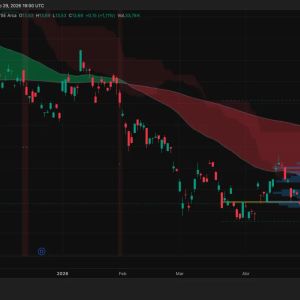
Summary Coinbase had a soft Q1, but the long-term platform story remains intact. Coinbase still reached an all-time high in crypto trading volume market share. CLARITY, Deribit, and new futures products could support long-term growth. I rate COIN a Hold because the upside is not enough for the risk. Introduction Coinbase Global, Inc. ( COIN ) has had a rough start to 2026, with the stock peaking around $444 in the 52-week range and currently trading near $175.69, down 60% since its peak. The Q1 2026 results on May 7 didn't really help, although shares briefly moved from roughly $196 to $217 in a couple of days, but they're down by 19% since then. In Q1, total crypto market capitalization and trading volumes both fell more than 20% QoQ, while Bitcoin and Ethereum prices came down, volatility dropped, and retail traders went quiet. SA But Coinbase is not just an exchange anymore, since the company is the largest crypto custodian in the world ( storing more than 12% of all crypto globally ), the distribution engine behind USDC (the second-largest stablecoin), the operator of Base (a blockchain that processed 99% of agentic stablecoin transaction volumes in Q1), and the owner of Deribit (the largest crypto options exchange in the world). It is now expanding into prediction markets, retail derivatives, equities, commodity futures, and U.S. equity index perpetual futures, launching June 8. The company calls this strategy the "Everything Exchange" and I actually believe that this expansion, trying to have different sources of revenue, is very positive for a company in a volatile environment like Coinbase. Operating Snapshot: The Context Behind My Thesis Digging into the earnings results to better understand how the business is doing, Coinbase had a rough Q1 2026. Total revenue came in at $1.41 billion, down 21% QoQ and 31% YoY, with a net loss of $394 million, and adjusted EBITDA dropping to $303 million, down 46% QoQ. But I don't think the earnings release only had bad news, because Coinbase's trading volume market share hit an all-time high in Q1, even while the crypto market collapsed more than 20% QoQ. I am not saying this offsets the weak numbers I said before, but even during a bad cycle, the business was able to grow market share. Coinbase Compared to the estimates, Q1 2026 was disappointing. Total revenue missed estimates by $66 million, and normalized EPS missed by $1.53. According to FactSet, transaction revenue was $755.8 million vs. the expected $805.2 million, while subscription and services revenue was $583.5 million vs. the expected $619.3 million. Adjusted EBITDA was $303 million vs. a consensus near $407 million. In my opinion, revenue and EBITDA missed clearly, but it is important to understand the context. The miss came from weaker crypto prices and lower volatility, which crushed trading activity across the entire industry, and not from Coinbase losing its competitive position. So I believe that the company is well positioned for a recovery in the crypto market. SA Coinbase's crypto trading volume market share hit an all-time high of 8.6% in Q1 2026, up from 8.0% in Q4 2025. Transaction revenue fell 23% QoQ, but total crypto market volumes fell 28% QoQ and spot volumes fell 37% QoQ, so Coinbase outperformed the market, which is a positive sign in my opinion. But I have to be honest about the other side too: assets on the platform fell to $294 billion from $376 billion at year-end, so users and assets did feel the pressure of a down market. But share is the metric I care about the most, because even in a bad environment, customers are still picking Coinbase over the competition. There is also the Subscription & Services line, where revenue was $584 million in Q1, or 44% of net revenue, with stablecoin revenue alone at $305 million, driven by an all-time high of $19 billion in average USDC held in Coinbase Products. S&S still dropped 14% YoY, and parts of it depend on interest rates, crypto prices, and staking reward rates, but it is materially more durable than transaction revenue, and management calls it "a durable buffer to volatility," (see Q1 2026 Update linked above), and I think that is the right way to describe it. If 44% of net revenue is less tied to trading activity, the cycles hurt less. Valuation: Not Enough Margin Of Safety Yet As I usually do in my articles, I built a scenario analysis using the EPS estimates that Seeking Alpha provides. I took the 2026 and 2027 consensus EPS of $1.22 in 2026 and $4.95 in 2027 and applied them to three scenarios: Base case: I assumed a 43x P/E non-GAAP, which is the 5-year average that the company traded at. Bull case: I assumed 50x P/E, which is close to where the stock ended 2025. Bear case: I assumed 26x P/E, close to the number the company closed 2024, and also closer to the median of its peers. Author A 43x multiple on $4.95 of 2027 EPS lands me at $212.85, which is a little bit more conservative than where the average target sits today at Yahoo Finance (around $233). At the current price of $175.69, my base scenario gives an implied upside of roughly 21%. Considering the risks and volatility involved in the stock, I don't think this margin of safety is enough to rate Coinbase a Buy, so I rate Coinbase a Hold. Looking at the Seeking Alpha grades (A for Profitability, D- for Valuation, C- for Growth), I see a business with good margins but very expensive and with some growth issues to work on. I understand crypto is a volatile market, and a soft Q1 was going to drag the trailing numbers down, but the valuation doesn't give me much margin of safety either. The profitability profile is close to a top-tier software company, not a traditional financial, and it is what justifies paying Coinbase's 5-year average multiple of 43x in my base case. But putting all three grades together, I see a high-quality business, full price, and growth that needs to recover before the multiple gets cheaper. The Catalysts That Keep Me Interested At the JP Morgan TMC conference that happened on May 20, President & COO Emilie Choi confirmed that the CLARITY Act advanced out of the Senate Banking Committee on a bipartisan basis, which she called "very, very unusual." Management sees a path for the bill to be signed this summer, and I wouldn't be surprised if that happens. I want to be clear that this is still management's expectation, not a done deal, but I see a meaningful upside if that happens. Emilie also framed stablecoins as just one part of the crypto opportunity, citing last year's GENIUS stablecoin bill as an example, with CLARITY potentially opening the broader market for tokenized assets and clearer rules of the road between the SEC and CFTC. Regulation has been one of the biggest overhangs on this stock since the IPO. If it actually clears this summer, the multiple could get a re-rating, and a lot of institutional money that has been sitting on the sidelines can finally plug in. Another important catalyst, in my opinion, is the Deribit integration. Coinbase closed the deal in 2025 , and at the JP Morgan conference, Emilie Choi said the technical integration should be complete by year-end 2026. For those who don't know, Deribit is the largest crypto options exchange in the world, and the combined platform gives Coinbase a global pool of liquidity that competitors cannot easily match. In my opinion, this integration is very important to consolidate the Everything Exchange. Also, on May 21, Coinbase announced the launch of the first perpetual-style equity index futures listed on a U.S.-regulated exchange, starting June 8. The initial contracts track AI, China, defense, and the top Nasdaq companies. That is a brand-new product category, and Coinbase is the first to bring it to a U.S.-regulated venue. What Keeps Me On The Sidelines On the Q1 outlook slide, management reported roughly $215 million of transaction revenue through May 5, and that covers a little more than the first third of Q2. Even with the company itself warning to be cautious about extrapolating, the math is not great in my opinion. If Coinbase continues to deliver the same results, Q2 transaction revenue could come in well below Q1's $756 million, which could hurt the stock price. The crypto market has been quiet, volatility is low, and these factors hurt transaction revenue. Coinbase has captured about 50% of USDC economics over the past year, and stablecoin revenue is now a large piece of the S&S line. I think there are two risks worth flagging. First, the underlying Circle Agreement is not an unconditional perpetuity, since the initial term is multi-year with renewal conditions, and the structure could be renegotiated over time. Management commentary suggests current terms remain intact, but this is a contract I am keeping an eye on. Second, the revenue is rate-sensitive, since a large portion comes from the yield on USDC reserves. If interest rates drop meaningfully, the yield drops with them, S&S is directly impacted, and the Q4 2025 letter itself flagged this dynamic when reserve rates fell after the October and December cuts. Great Company, Not My Entry Point I believe that Coinbase is in better shape than it appears, with market share at an all-time high, S&S at 44% of net revenue, and the Everything Exchange showing early evidence of working. The catalysts that I mentioned are also becoming real, with CLARITY advancing, Deribit on track, and equity index perpetual futures launching June 8. But my base case puts fair value around $213, only about 21% above today's price, while the bear case would imply meaningful downside. For a stock with this much volatility and a soft Q2 likely on the way, and an EPS estimate for 2027 more than 4x the 2026 estimate, that is not a wide enough margin of safety for me. So I am at Hold. I like the company and the long-term direction; I just do not like the entry point.